
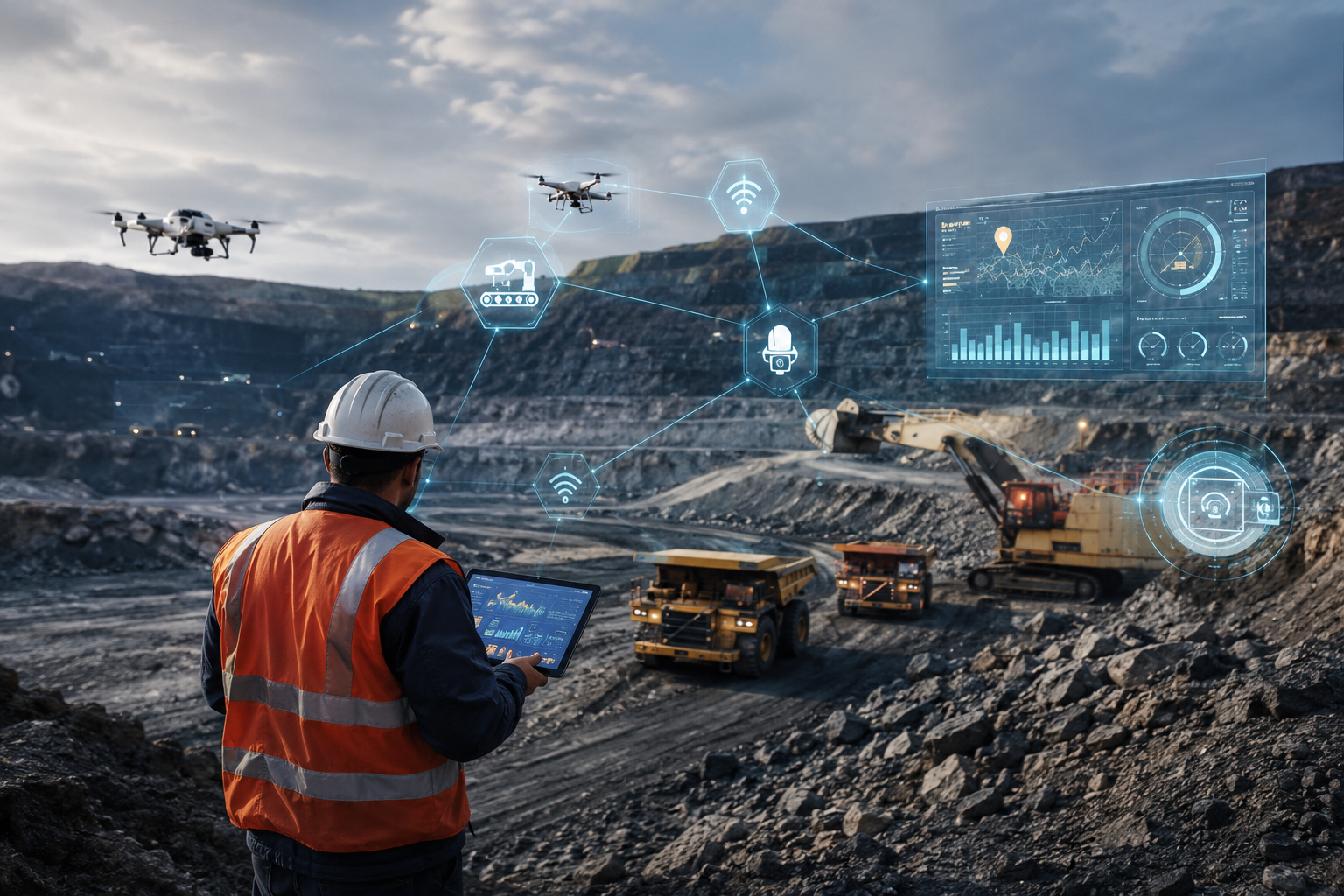

Most conversations about ai in mining point straight to billion dollar automation programs built by the world’s largest miners. That scale is out of reach for a mid-tier operator, and most sites do not need it. What a mid-tier operator actually needs is a set of smaller, buildable systems: a mobile app that keeps working without network coverage, a dashboard that sits on top of the maintenance software already in place, a fleet tracking tool sized to an actual fleet.
This guide covers four areas where an ai development company in Australia can build something a mining operator can use within months, not years. Vrinsoft Pty Ltd is a leading mining software development company In Australia with real world experience. Here is how AI can help mining operations and how can you start small to and build something that can improve safety and cost saving.
Why Mining Companies Are Investing in AI Right Now
Four real pressures explain the current push toward artificial intelligence development in mining industry projects across the country.
Regulatory pressure
Western Australia’s Work Health and Safety (Mines) Regulations 2022 came into effect on March 31, 2022. It requires every mine operator to build and maintain a formal Mine Safety Management System, file quarterly WHS reports to the regulator instead of the old monthly forms, and it introduced industrial manslaughter as an offense for serious breaches.
The cost of unplanned downtime
A failed part on a remote site can mean days of lost production while a replacement gets shipped in. Scheduled, condition-based maintenance reduces the odds of that happening at the worst possible time.
Workforce and connectivity limits
Fly-in fly-out rosters, underground zones, and pits far from town all share one problem: unreliable or nonexistent network coverage. Any software built for a mine site has to account for this from day one, not as an afterthought.
Competitive pressure
As more operators in the Australia mining industry adopt AI tools for safety and maintenance, sites without similar systems fall behind on both compliance reporting and cost per tonne produced.
Where AI Already Shows Up in Mining Operations
Across the future of AI in mining industry conversation, four categories cover most of what a development partner can realistically build today. The next four sections go deeper on each row, followed by a look at what Australia’s largest miners have already proven at scale.
1. AI Safety Monitoring for Mining Operations
Mining sites contain heavy machinery, hazardous zones, moving vehicles, and workers operating in difficult conditions. A supervisor cannot watch every zone at once, and a paper-based safety check only catches what someone remembers to write down after the fact. AI-based monitoring closes that gap by watching continuously and flagging a problem the moment it happens. That’s where AI development services in Australia like Vrinsoft Pty Ltd comes in and build system that protect people and assets.
PPE Detection with Computer Vision
Cameras positioned at site entry points and high-risk zones can run continuous checks for:
- Helmet detection
- Safety vest detection
- Restricted area monitoring
- Entry compliance at gates and checkpoints
Hazard Detection
The same camera and sensor infrastructure can be trained to flag site conditions beyond PPE, including:
- Rockfall risk
- Smoke detection
- Fire detection
- Water accumulation
- Equipment obstruction on walkways or haul roads
Fatigue and Driver Monitoring
In-cab cameras and sensors can track operator condition during a shift, covering:
- Driver distraction
- Fatigue detection
- Alert generation for the operator and control room
- Shift monitoring across a full roster
Built for Sites With Unreliable Network Coverage
Most mine sites have patchy or nonexistent coverage across large parts of the operation, and a safety system that stops working the moment signal drops is not a safety system worth building. The proven approach is to process detection locally rather than depend on a constant connection to the cloud:
- Cameras at fixed checkpoints run detection models directly on a local edge device, so PPE and entry checks keep working even if the site’s main connection goes down.
- Field-based hazard reports and inspection logs are captured through a mobile app that stores data on the device first.
- Reports queue locally and sync automatically once the device reconnects to the site network or a vehicle carrying signal comes back into range.
- No detection or logging function depends on a live internet connection to work at the moment it is needed.
Business Benefits
Sites running this kind of system report improvements in:
- Incident reduction
- Faster response times
- Regulatory compliance
- Continuous site monitoring across every shift, not just when a supervisor is present
The best use of AI in mining industry is safety and security. As it can work non stop and provide useful information that can save lives everyday.
2. Predictive Maintenance Using AI
Reactive maintenance costs more than scheduled maintenance almost every time. A part that fails without warning stops production, forces an emergency repair, and often damages surrounding components in the process. AI-based predictive maintenance works by reading equipment condition continuously and scheduling a repair before failure happens, not after.
Data Sources
A predictive maintenance model for mining needs a steady feed of real operating data, typically including:
- IoT sensors installed on rotating and moving parts
- Equipment telemetry pulled from onboard systems
- Historical maintenance records
- Vibration analysis
- Temperature readings
AI Predictions
Once trained on this data, a model for AI in mining can generate forward-looking outputs such as:
- Component wear estimates
- Failure probability scoring
- Maintenance scheduling recommendations
- Remaining equipment life projections
Suitable Mining Assets
This approach applies well to high-value, high-use equipment, including:
- Excavators
- Haul trucks
- Crushers
- Conveyors
- Drilling equipment
- Pumps
Built for Brownfield Sites and Limited Connectivity
Most Australian mine sites run a mix of older machinery and newer sensor hardware, and technicians often work in zones with no signal at all. A predictive maintenance system needs to work with both realities:
- Sensor data pipelines that pull from existing hardware instead of requiring a full equipment replacement
- Offline-capable inspection apps for technicians logging manual readings in areas without coverage
- Local data storage on the device, with automatic sync once the technician is back in range
- Alerts routed through whichever channel actually reaches a maintenance lead at that site, whether that is a text, an app notification, or a radio dispatch
Business Value
Sites using predictive maintenance typically see gains in:
- Reduced downtime
- Lower maintenance costs
- Longer equipment life
- Better spare parts planning
- Increased production availability
3. AI Fleet Tracking and Equipment Management
Mining fleets generate a constant stream of operational data every shift. Most of that data goes unused once a shift ends, sitting in a system nobody reviews closely. AI-based fleet tracking turns that same data into a working tool for the fleet manager, not just a record for the archive.
Vehicle Tracking
Core tracking functions include:
- GPS monitoring across the full fleet
- Route optimisation based on live site conditions
- Idle time analysis
- Fuel usage tracking
Equipment Utilisation
Beyond location, a fleet system can measure:
- Active hours per vehicle
- Idle equipment across a shift
- Equipment availability against planned schedules
- Asset performance over time
AI Route Optimisation
Route planning benefits from AI analysis in several ways:
- Traffic management across haul roads
- Haul route optimisation based on load and site conditions
- Fuel reduction through smarter routing
- Travel time analysis across shifts and routes
Built for Vehicles Moving Through Dead Zones
Large mine sites often have signal gaps between the pit, the processing plant, and the site office. A fleet system that loses data every time a vehicle passes through a dead zone is not giving an accurate picture of the day:
- GPS units log position data locally when a vehicle is out of range
- Data syncs automatically once the vehicle reconnects to the site network
- In-cab apps continue showing route and load instructions even mid dead zone
- No shift report ends up with gaps from vehicles that simply drove somewhere unmonitored
Business Outcomes
Fleet operators using this approach typically report:
- Higher fleet productivity
- Lower fuel costs
- Better scheduling
- Improved operational visibility across every shift
4. AI Site Automation for Mining Companies
A lot of site work is repetitive by nature: checking the same infrastructure, tracking the same production numbers, compiling the same report every quarter. Automation exists to take that repetitive load off a team so people spend time on decisions instead of data entry.
Automated Inspection Systems
Automation replaces manual walk-throughs with:
- Drone inspections of hard-to-reach infrastructure
- Camera monitoring at fixed points
- Infrastructure inspection scheduling and logging
- Tailings monitoring over time
AI Production Monitoring
Production data can be tracked automatically, covering:
- Material movement across the site
- Processing rates through the plant
- Stockpile measurement
- Ore quality analysis
Operational Dashboards
A well-built dashboard pulls information from across the site into one place, combining data from:
- ERP systems
- IoT devices
- Fleet systems
- Maintenance software
- Production systems
Managers working from this dashboard get access to:
- Live KPIs
- Operational alerts
- AI-generated recommendations
- Production forecasts
Built to Bridge Legacy and Modern Systems
Most Australian mines run older hardware next to newer platforms, and a site automation project rarely starts from a blank slate:
- Integration layers connect legacy equipment to modern dashboards instead of requiring a full system replacement
- Reporting pulls automatically from existing data sources rather than needing manual entry ahead of a compliance deadline
- Remote monitoring dashboards work even when a site connection is intermittent, queuing updates until the link is stable
- Rollouts are scoped one system or one site at a time, rather than attempted as a single company-wide changeover
Real World Applications: What Rio Tinto and BHP Have Actually Built
The systems above are the kind of scoped, buildable projects most operators start with. Here is what the same four categories look like once a company scales them to the size of Australia’s largest miners.
Rio Tinto's AutoHaul rail network
A 940 million US dollar program running 200 locomotives across 1,700 kilometres of track in the Pilbara, moving iron ore from sixteen mines to four port terminals, fully autonomous since June 2019 and monitored from an operations centre in Perth. Rio Tinto states the system removes almost 1.5 million kilometres of road travel a year, road travel once needed just to relieve train drivers mid journey.
Rio Tinto's autonomous trucks and drills
More than 130 autonomous haul trucks and 40 autonomous drills run across seven Pilbara sites, with the truck fleet passing the one billion tonne milestone in January 2018.
BHP's South Flank conversion
BHP began converting a fleet of 41 Komatsu haul trucks at its South Flank site to autonomous operation in June 2022, alongside about 180 supporting pieces of equipment including excavators, dozers, and water trucks.
The pattern behind all three
Every one of these started as a scoped, site-specific project. Rio Tinto’s rail automation began with a concept design agreement in 2006 and reached full deployment thirteen years later. BHP’s South Flank conversion applies to one site, not a blanket policy across every BHP operation. That staged approach, one project proven before the next one starts, is the model a mid-sized operator can realistically follow.
Also Read: Real World AI Development Use Cases Across 10+ Different Industries
What It Takes to Build AI Systems for Mining Operations
Successful AI projects begin long before a model is trained or software is deployed. Mining companies need reliable data, the right technology stack, and a practical implementation plan that fits existing operations. Reviewing these factors early helps reduce project risk and supports long-term adoption.
Data Readiness
AI models rely on accurate operational data. Before development begins, assess whether existing systems already collect the information needed or whether additional sensors and monitoring devices should be installed.
Common data sources include:
- Equipment telemetry
- IoT sensor data
- Maintenance records
- Production data
- GPS and fleet data
- Inspection reports
- Environmental monitoring data
Choosing the Right AI Technologies
Different operational challenges require different AI technologies. Selecting the right combination depends on the business objective rather than following a standard technology stack.
| Technology | Typical Mining Applications |
|---|---|
| Machine Learning | Predictive maintenance, production forecasting, equipment performance analysis |
| Computer Vision | PPE detection, hazard monitoring, automated inspections, security monitoring |
| IoT Sensors | Equipment health monitoring, environmental monitoring, asset tracking |
| Edge AI | Local data processing for remote sites with limited network connectivity |
| Generative AI | Maintenance assistants, technical document search, inspection summaries, operational reporting |
| Cloud Platforms | Centralised dashboards, analytics, AI model management, cross-site reporting |
Integration with Existing Systems
Most mining operations already use several business and operational platforms. AI solutions should integrate with these systems rather than replace them.
Typical integrations include:
- ERP systems
- CMMS platforms
- Fleet management software
- SCADA systems
- IoT infrastructure
- Business intelligence dashboards
Start with a Pilot Project
Rather than deploying AI across an entire operation, begin with a focused use case that delivers measurable value.
Common pilot projects include:
- Predictive maintenance for one equipment category
- PPE detection at high-risk locations
- Fleet tracking for selected vehicles
- Automated inspections for a specific site
Select the Right Development Partner
Technology is only one part of a successful implementation. An experienced AI development partner should also help with planning, integration, security, and future expansion.
Key evaluation points include:
- Experience building custom AI solutions
- Integration with existing mining systems
- Data ownership and governance
- Cybersecurity practices
- Ongoing support and model improvement
- Ability to scale from one site to multiple operations
How Vrinsoft Pty Ltd Supports AI Development for Mining
Every mining operation has different infrastructure, equipment, and operational goals. At Vrinsoft Pty Ltd, we develop custom AI solutions that integrate with your existing systems and address practical challenges across mining sites.
Our approach includes:
- Data and infrastructure assessment to evaluate existing systems, sensors, and operational readiness.
- Pilot-based development focused on a single use case such as safety monitoring, predictive maintenance, fleet tracking, or site automation.
- Integration with ERP, CMMS, IoT platforms, fleet management software, and other operational systems.
- Scalable AI solutions that can expand from one site or equipment category to multiple locations as business needs grow.
If your team is planning AI development for mining operations, Vrinsoft can help identify practical use cases, assess data readiness, and build a solution aligned with your operational requirements. Book a discovery call to discuss your project.
Conclusion: AI Development Is Driving Safer, Smarter, and More Productive Mining Operations
AI development is helping mining companies improve far more than automation alone. From safety monitoring and predictive maintenance to fleet tracking and site automation, practical AI solutions help reduce downtime, improve operational visibility, and support faster decision-making across mining sites. Rather than investing in large-scale transformation from day one, many operators achieve better results by starting with a focused use case that delivers measurable business value before expanding across additional equipment, teams, or locations.
If you’re planning an AI initiative for your mining operation, Vrinsoft Pty Ltd can help you identify practical opportunities and develop a solution that aligns with your existing systems and operational goals. Whether you’re looking to build a predictive maintenance platform, an AI-powered safety monitoring system, or a custom mining software solution, our team is ready to help. Call us at 0480027297 or visit our Contact Us page to discuss your project with our AI development specialists.