

‘’Most retail chains lose revenue every day from systems that should be driving growth.’’
Yes, retail leaders across Australia ask the same question: why are stores busy yet revenue growth feels slow? Many chains still rely on disconnected POS tools, manual inventory tracking, and limited customer data.
We conducted a study over 10+ retail businesses and found that, it creates revenue leakage and poor customer targeting. Some retailers report online cart abandonment rising by 28% and in-store conversion falling by nearly 15%.
What happens when technology works together and supports every store decision?
Common issues we see across retail groups include: –
- Stock visibility gaps across locations
- Slow reporting that delays pricing or promotion decisions
- Customer data spread across multiple platforms
- Marketing campaigns that miss high-value buyers
A structured retail digital transformation roadmap can solve these operational problems.
With the right digital transformation services, retailers can increase conversion rates, improve inventory accuracy, and turn data into daily decisions.
This post explains the exact steps. So, let’s begin.
Digital Transformation in Retail- A Quick Overview
Digital transformation in the Australian retail sector involves the integration of advanced technologies such as artificial intelligence (AI), cloud computing, and data analytics to improve customer experiences and operational efficiency.
Retailers are adopting omnichannel strategies, which allow for personalised shopping experiences through mobile apps and real-time inventory systems. Also, they are automating supply chains to reduce costs.
Notable examples of digital transformation retail include Shopify POS, which facilitates seamless online and offline integration, and Google Cloud, which aids in demand forecasting.
These innovations are essential for driving growth in a competitive marketplace
What is the Size of the Retail Industry in Australia?
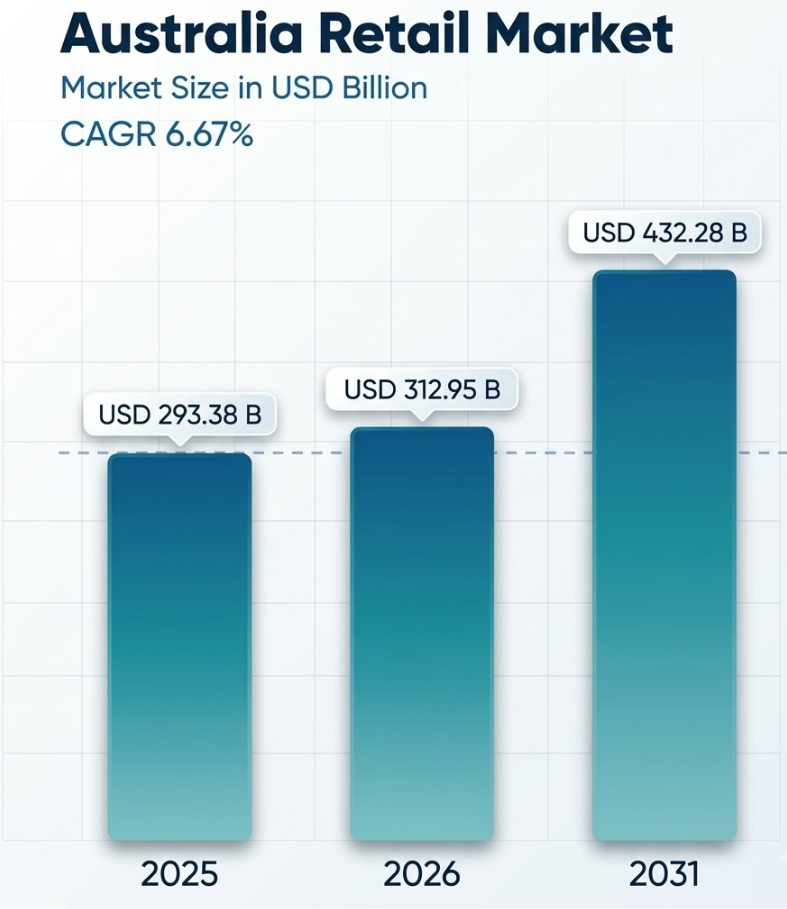
According to a report: –
- The Australian retail market was valued at approximately USD 293.38 billion in 2025
- It is projected to grow from USD 312.95 billion in 2026 to USD 432.28 billion by 2031, with a compound annual growth rate (CAGR) of 6.67% during the forecast period from 2026 to 2031.
Key Highlights/Stats
- In terms of product categories, Food and Beverage accounted for the largest revenue share at 47.38% in the Australian retail market in 2025.
- Personal and Household Care is expected to grow at a CAGR of 11.24% through 2031.
- Regarding store size, Mid-Format stores held a 51.76% share of the Australian retail market in 2025, while Large-Format stores are forecasted to grow at a CAGR of 12.36% through 2031.
- In the distribution channel category, Supermarkets and Hypermarkets represented an 84.87% share of the Australian retail market in 2025.
- Online channels are anticipated to advance at a CAGR of 13.26% through 2031.
- In the price segment, Mass/Value products commanded a 53.33% share of the Australian retail market in 2025, while Luxury items are projected to grow at a CAGR of 10.29% through 2031.
What is the Need for Digital Transformation in Australian Retail Industry?
The Australian retail industry must undergo digital transformation to address significant structural and operational challenges that are currently eroding productivity, inflating costs, and undermining competitiveness.
Below are some of the reasons for the need of retail digital transformation: –
Productivity Crisis
Retail productivity is negatively affected by fragmented systems and manual processes, which directly impact margins and profitability.
Regulatory Fragmentation
A “patchwork” of inconsistent state and territory regulations imposes a “$26 billion fragmentation tax” over the next decade, forcing retailers to navigate costly parallel compliance systems.
Therefore, highlighting the need for digital transformation in retail industry.
Escalating Retail Crime
Organised retail crime and the illicit tobacco trade are damaging business viability, driving up insurance costs, and compromising worker safety.
Unfair Competition
Some ultra-cheap offshore retailers are able to bypass Australian consumer, privacy, and safety laws, creating distorted competition and an uneven playing field.
Rising Compliance Burden
The total regulatory compliance burden is approaching a staggering $240 billion per year, which impedes investment and innovation.
Legacy System Constraints
Outdated technology stacks and poor data quality hinder real-time inventory visibility, leading to missed order commitments and operational friction.
Supply Chain Volatility
Ongoing global trade volatility and geopolitical risks disrupt supply chains, making it challenging to maintain stock availability and manage costs effectively.
Why Businesses in Australia are Moving Towards Digital Transformation?
Australian businesses are increasingly adopting retail digital transformation to improve efficiency and meet the evolving expectations of tech-savvy customers.
1. Enhanced Customer Experience
Digital transformation in the retail industry will facilitate personalised and omnichannel interactions, allowing businesses to provide smooth service and instant support that meet customer demands.
2. Operational Efficiency
Automating routine tasks and digitising workflows allows companies to streamline operations, reduce human error, and lower operational costs.
3. Data-Driven Decision Making
Advanced analytics offer valuable insights into market trends and consumer behaviour, leading to more accurate forecasting and strategic planning.
4. Market Advantage
By leveraging the latest technologies, Australian businesses can differentiate themselves, innovate more quickly, and remain ahead of both local and international competitors.
5. Improved Agility
Cloud computing and digital platforms empower businesses to rapidly adapt to market disruptions, such as supply chain issues, and to scale resources as needed.
6. Cybersecurity and Compliance
Modern digital infrastructures typically offer improved security features, helping businesses protect sensitive data and adhere to increasingly strict privacy regulations.
7. Attracting Talent
A digitally enabled workplace supports flexible work arrangements, which are essential for attracting and retaining top talent that values modern work environments.
8. Sustainability Goals
Digital transformation contributes to sustainability by reducing paper usage, optimising supply chains to lower emissions, and promoting remote work, which helps reduce carbon footprints.
How to Implement Digital Transformation in Retail Industry?
To successfully implement digital transformation trends in retail, Australian retailers should focus on several key areas: –
1. Unify Customer Data
Consolidate data from all touchpoints into a single platform to create comprehensive customer profiles for AI-powered insights.
2. Deploy AI Strategically
Use artificial intelligence for demand forecasting, inventory management, and personalised product recommendations.
3. Create Omnichannel Experiences
Integrate online and offline channels, offering services like click-and-collect and consistent loyalty programs to enhance customer engagement.
4. Prioritise First-Party Data
Build trust by collecting preference data directly from customers through interactive experiences and transparent exchanges.
5. Strengthen Technological Foundation
Invest in scalable, cloud-managed infrastructure to ensure reliable connectivity for all digital tools.
6. Rethink Post-Purchase Interactions
Transform the checkout process into an engagement opportunity by offering relevant products or membership options.
7. Upskill Your Workforce
Reskill employees to work collaboratively with AI tools, shifting their focus from routine tasks to more strategic roles.
8. Ensure Strong Security
Implement real-time monitoring to detect system issues, prevent fraud, and protect customer data.
9. Focus on Key Segments
Cater to core customer groups, such as Gen Z, by providing the tailored experiences they expect for personalisation.
10. Follow a Phased Roadmap
Plan clear digital transformation steps that align technology investments with specific business outcomes, such as customer retention.
Check This Out – The Ultimate Digital Transformation Checklist for Businesses
Things to Consider When Implementing Digital Transformation for Retail Chains
Success in digital transformation roadmap for retail chains hinges on effectively blending innovative technology with solid data practices, while also maintaining the human touch that Australian consumers appreciate.
1. Build Strong Data Foundations
Effective AI tools require clean, well-governed first-party data and real-time inventory systems to work optimally.
2. Keep the Human Element
Use technology to allow staff to focus on higher-value services, ensuring that customers still have the choice between digital interactions and personal service.
3. Prepare for AI-Driven Shopping
Optimise your content for discovery through AI tools, such as ChatGPT, which shoppers are increasingly using for product research.
4. Fix Omnichannel Gaps
Address inventory inconsistencies by using unified commerce platforms that provide a single, real-time view of stock across all channels.
5. Compete on Speed and Trust
Differentiate your offerings from global competitors by providing quick local fulfillment and reliable in-store experiences.
6. Better Productivity with AI
Implement AI for demand forecasting and automation to effectively manage labour costs and enhance overall efficiency.
7. Embrace Unified Commerce
Integrate mobile point of sale (POS), customer loyalty programs, and fulfillment options so that stores can function as efficient online delivery hubs.
8. Personalise with Privacy
Use consent-driven first-party data from surveys and loyalty programs to customise customer experiences without compromising trust.
5 Successful Retail Businesses Who Succeeded With Digital Transformation
Several Australian retail companies have significantly increased their sales, customer engagement, and operational control by using technology to modernise their store and online operations.
Below are the popular retail digital transformation examples: –
Woolworths Group
- Implemented advanced data analytics, smart inventory systems, and online grocery services. This initiative increased their delivery capacity and improved product availability across various stores.
JB Hi-Fi
- Integrated its physical stores with its e-commerce platform, enabling customers to check stock online and pick up products in-store. This strategy improved their omnichannel sales.
Coles Group
- Invested in automated distribution centres, digital supply chain tracking, and improved online ordering. These enhancements helped reduce stock issues and increased delivery speed.
Officeworks
- Use digital platforms, customer data tools, and same-day services to enhance both the online shopping experience and in-store interactions.
Kmart Australia
- Adopted strong e-commerce systems, mobile shopping tools, and digital inventory visibility, which allowed the brand to manage large order volumes effectively and improve customer convenience.
Final Thoughts- Implement Digital Transformation in Your Retail Chain by Partnering With Vrinsoft Pty Ltd
Retail chains across Australia are under constant pressure to keep stores connected, data accurate, and customers engaged. Without a clear technology plan, teams spend more time fixing operational gaps than growing revenue.
According to our project analysis, retailers that follow a structured digital roadmap often see inventory accuracy improve by nearly 30% and customer retention rise significantly.
Working with the right retail digital transformation partner makes this transition practical and measurable. At Vrinsoft Pty Ltd, our team delivers custom digital business transformation services that align technology with real retail operations.
Businesses looking for trusted support for digital transformation in Melbourne can rely on our experience across POS systems, retail apps, analytics platforms, and omnichannel commerce solutions.
You can also explore our portfolio to see how we help retail businesses modernize operations and increase growth.
Are you ready to transform your retail chain before competitors do?
Contact our experts today.