

The biggest productivity challenge in many businesses isn’t a lack of talent. It’s the amount of time your team spends on repetitive work.
Your customer service team answers the same questions every day. Employees search through documents to find information. Sales teams prepare follow-ups manually. Operations teams spend hours turning data into reports.
What if AI could handle some of that work?
You have probably seen what generative AI can do. It can write content, summarise information, answer questions, create images, and generate code in seconds.
But the real business opportunity starts when you connect those capabilities to your own systems and data.
Could an AI assistant answer customer questions using your product information? Could employees ask questions about company policies and get answers instantly? Could your CRM, ERP, ecommerce platform, or internal software use AI to handle routine tasks?
These are practical generative AI applications that businesses can build today.
At Vrinsoft Pty Ltd, we help Australian businesses turn these ideas into working AI solutions through AI development services. We connect AI with your data, software, workflows, and business requirements so it can solve a specific problem.
So, what could generative AI actually do for your business?
In this blog, we’ll look at practical generative AI examples, real-world generative AI use cases, and how organisations across industries are using AI to improve everyday business operations.
Generative AI in Australia: Adoption Trends and Business Opportunities
AI adoption is growing, but the most successful businesses are moving beyond simple AI tools and looking at how AI can improve entire processes.
Recent Australian research highlights this shift.
| AI Adoption Insight | Australian Market Data |
|---|---|
| SME AI adoption | 43% of SMEs reported AI adoption |
| AI use for content generation | 54% of adopters |
| AI use for data analytics | 54% of adopters |
| Organisations using autonomous AI agents | 69% |
| Organisations reporting efficiency gains | 69% |
Sources: National AI Centre and Deloitte Australia.
Deloitte’s latest enterprise AI research found that while 61% of Australian organisations report efficiency improvements from AI, only 30% are using AI to fundamentally transform the way they work. At the same time, 69% are already using autonomous AI agents.
That creates a significant opportunity.
Many businesses have started experimenting with AI. Far fewer have integrated it into the systems and workflows that drive revenue, customer experience, and operational performance. This is where AI implementation, AI integration services, and custom AI business solutions can become important.
What Can Generative AI Actually Do for Your Business?
Before looking at individual generative AI business applications, start with the work your team is already doing every day.
Are employees repeatedly answering the same questions? Searching through hundreds of documents? Preparing similar reports? Writing product descriptions? Moving information between systems? Spending hours summarising customer interactions?
These are the kinds of processes where generative AI can become useful.
Depending on your requirements, you can use generative AI to:
- Answer customer questions using your business information
- Search and summarise internal documents
- Generate reports and business content
- Assist sales and customer service teams
- Personalise customer interactions
- Support software development
- Extract information from documents
- Build AI assistants into existing applications
- Automate parts of knowledge-based workflows
- Create enterprise copilots connected to business systems
The important part is identifying where AI fits into your workflow.
For example, if you only need help writing emails, an existing AI tool may solve the problem. If you want customers to ask questions about live product information, your AI needs to interact with your business systems.
That is where custom AI development can help you move from using AI as a standalone tool to building it into the way your business operates.
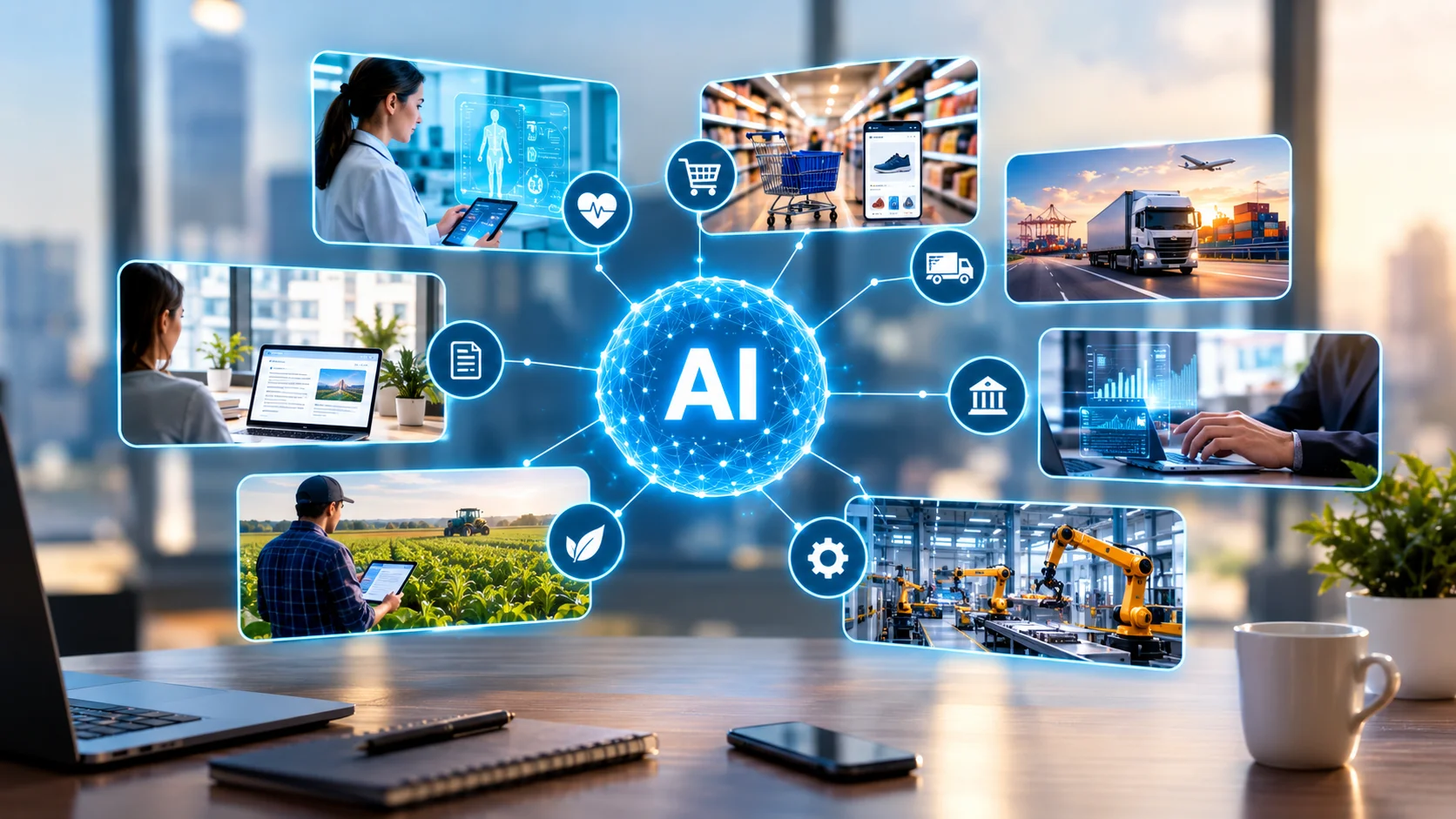
Generative AI Use Cases by Industry – A Quick Overview
While the technology behind generative AI may be similar, the way businesses use it varies significantly across industries.
The most successful implementations solve a specific business challenge rather than applying AI for the sake of innovation.
| Industry | Common Generative AI Applications |
|---|---|
| Healthcare | Documentation assistance, patient communication, report generation |
| Retail & Ecommerce | Product recommendations, AI shopping assistants, content generation |
| Logistics | Shipment tracking, operational reporting, workflow support |
| Financial Services | Document processing, compliance support, customer assistance |
| Manufacturing | Knowledge management, maintenance support, operational insights |
| Professional Services | Proposal creation, research support, document summarisation |
The following examples show how businesses are applying generative AI to improve efficiency, automate repetitive tasks, and create better experiences for customers and employees.
7 Generative AI Examples That Could Transform Business Operations
There is no universal AI application that works for every business. Your best opportunity may be sitting inside a process your team currently considers routine.
Here are some practical areas to examine.
1. AI Customer Service Assistants
How many customer questions does your team answer repeatedly?
“Where is my order?”
“What is your return policy?”
“Does this product come with a warranty?”
If your team handles hundreds of similar questions, a generative AI customer service assistant could manage a significant portion of those interactions.
You could connect it with your:
- Product catalogue
- FAQ database
- CRM
- Order management system
- Knowledge base
- Website or mobile application
The system can generate responses using approved business information, while complex or sensitive enquiries can be transferred to a human employee.
What this means for you: Your support team can spend less time answering routine questions and more time handling complex customer needs.
For businesses considering AI chatbot development, customer service is a practical use case because the existing workload is measurable.
2. AI Knowledge Assistants for Your Employees
How long does it take employees to find company policies, product information, technical documents, or internal procedures?
A custom AI knowledge assistant can give employees a conversational interface for accessing approved company information.
For example, an employee could ask: “What documents do I need to submit to onboard a new supplier?”
Instead of searching through folders and internal portals, the AI can retrieve relevant information and present the answer.
A Retrieval-Augmented Generation (RAG) architecture can connect the application with:
- Policies
- Product documentation
- Training material
- Technical documents
- Internal procedures
- FAQs
- Knowledge bases
At Vrinsoft, we develop RAG-based AI solutions that connect generative AI with business knowledge and enterprise systems.
What this means for you: Employees can find the information they need faster without searching across multiple internal sources.
3. Document Processing and Reporting
Contracts, reports, proposals, applications, invoices, meeting notes, and customer documents can all require significant manual review.
A generative AI solution can read incoming documents, extract relevant information, summarise the contents, and produce a structured output.
For example:
Document received → AI extracts information → AI summarises key points → Employee reviews → Information enters your workflow
Applications include:
- Contract summaries
- Business reports
- Proposal preparation
- Meeting summaries
- Customer communications
- Document classification
- Internal reporting
Human review can remain part of the workflow where required.
What this means for you: Your team can spend less time processing documents and more time acting on the information they contain.
4. Personalised Sales and Marketing
Your sales and marketing teams already have valuable customer and product information. The challenge is turning that data into relevant communication at scale.
An AI sales assistant could review CRM records, previous emails, meeting notes, and product information to prepare a customer meeting brief. Afterward, it could help draft a follow-up based on the discussion.
For ecommerce businesses, generative AI can also support:
- Product descriptions
- Product recommendations
- Customer questions
- Personalised emails
- Campaign variations
- Product comparisons
Connecting the AI with your existing systems gives sales and marketing teams assistance within the workflows they already use.
What this means for you: Your team can reduce preparation time while delivering more relevant customer communication.
5. Generative AI for Healthcare
Healthcare organisations face additional considerations around patient information, privacy, accuracy, documentation, and professional oversight.
Potential applications include:
- Documentation assistance
- Information summarisation
- Administrative support
- Report preparation
- Knowledge retrieval
- Patient communication
Australian healthcare organisations are already testing practical AI applications. The NSW Agency for Clinical Innovation, for example, documents the use of generative AI to assist with report and correspondence drafting while clinicians retain review responsibility.
For healthcare businesses, the key development question is: How can AI assist your team while maintaining the controls your organisation requires?
That needs to be addressed during architecture and development.
What this means for you: You can identify useful AI applications while keeping privacy, accuracy, and professional oversight central to the solution.
Also Read: AI Development in Healthcare: Solutions, Use Cases & Cost in Australia
6. Generative AI for Retail and Ecommerce
Managing hundreds or thousands of products can make product content and customer queries difficult to handle manually.
A custom AI application could help customers compare products, answer questions, find relevant items, or receive personalised recommendations.
It could connect with your:
- Ecommerce platform
- Product catalogue
- Inventory system
- Customer data
- CRM
- Website search
This allows the AI to work with your products and business rules rather than provide generic responses.
What this means for you: You can use AI to improve product discovery and customer interactions while supporting internal content and service teams.
7. AI Assistants for Logistics and Operations
Logistics information is often spread across delivery systems, warehouse software, supplier communications, customer records, and operational reports.
An AI operations assistant can bring relevant information together.
A manager could ask: “Which deliveries are delayed today, what is causing the delays, and which customers are affected?”
The AI could retrieve information from connected systems and provide a concise response.
Potential applications include:
- Shipment information
- Operational reporting
- Supplier communication
- Document processing
- Internal knowledge
- Workflow assistance
What this means for you: Managers can get relevant operational information faster and spend less time pulling data from multiple systems.
Also Read: AI in Logistics: From Inventory Forecasting to Delivery Optimization
What Does a Business Need to Build a Generative AI Application?
You may already have a generative AI use case in mind. The next step is turning that idea into a practical generative AI application that works with your business.
A successful generative AI solution depends on several core components.
1. Business Data
Your AI needs access to the right information to deliver useful results.
This may include:
- Product and customer data
- Internal documents and policies
- Transaction records
- Operational data
- Knowledge bases
You also need to determine where the data is stored and how it can be accessed securely.
2. The Right AI Model
Model selection should match your generative AI application’s requirements.
Response quality, speed, cost, context, data requirements, and functionality can all influence which AI model you use. A customer service assistant may have very different requirements from an enterprise AI solution.
3. RAG and Knowledge Architecture
If your AI needs to work with private business information, Retrieval-Augmented Generation (RAG) can connect the model with your approved data sources.
The application retrieves relevant information before generating a response, helping your custom AI solution provide answers based on business-specific knowledge.
4. APIs and System Integrations
Your generative AI application may need to connect with:
- CRM and ERP systems
- Ecommerce platforms
- Databases
- Cloud services
- Websites and mobile apps
AI integration services can connect these systems so your AI works within existing business workflows.
5. Security and Access Controls
AI applications may handle sensitive business information. Authentication, permissions, data handling, and monitoring should therefore be part of the AI development architecture.
Users should only be able to access information they are authorised to see.
6. Testing and Monitoring
Before launch, test your generative AI solution against real business scenarios.
Check response accuracy, handling of unknown questions, human handover, sensitive data handling, and ongoing performance.
These steps help turn an AI experiment into a reliable custom AI development project that can support your business at scale.
How Much Does Generative AI Development Cost in Australia?
One of the most common questions businesses ask is: “How much will it cost?”
The answer depends on the complexity of the solution.
| AI Project Type | Typical Cost (AUD) |
|---|---|
| AI MVP / Proof of Concept | $30,000 - $60,000 |
| AI Business Application | $60,000 - $120,000 |
| Enterprise AI Platform | $60,000 - $120,000 |
These are indicative market ranges, and actual costs depend on project scope and solution complexity.
- Factors that influence cost include:
- Data readiness
- System integrations
- AI architecture
- User volume
- Security requirements
- Cloud infrastructure
- Ongoing optimisation
A customer-facing AI chatbot will naturally require a different investment from a fully integrated enterprise AI platform connected to multiple business systems.
Also Read: AI Development Cost from Planning to Implementation: What to Expect in 2026
What Determines Generative AI ROI for Businesses?
When evaluating an AI project, cost is only part of the decision.
The bigger question is whether the solution can deliver measurable business value. The most successful AI initiatives are linked to specific business goals rather than technology alone.
Generative AI can help businesses:
- Reduce customer support workloads through faster responses
- Automate document processing and reporting tasks
- Improve employee productivity with faster access to information
- Support sales and customer engagement activities
- Streamline workflows and reduce manual effort
The strongest AI projects focus on outcomes such as improved efficiency, faster turnaround times, higher customer satisfaction, or reduced operational costs.
When AI is aligned with clear business objectives, it becomes easier to measure success and justify the investment.
Where Should You Start With Generative AI?
If you’re considering AI development, don’t start with the technology.
Start with the problem.
Ask yourself:
- Which tasks consume the most employee time?
- Which customer questions appear repeatedly?
- Where is information difficult to access?
- Which processes rely heavily on manual work?
- What could be automated without reducing quality?
The answers often reveal the best opportunities for AI adoption.
The strongest AI projects are not built around trends. They are built around measurable business outcomes.
Why Choose Vrinsoft Pty Ltd for AI Development in Australia?
Developing a successful AI solution requires more than AI expertise.
It requires software engineering, cloud architecture, integration experience, security knowledge, and a clear understanding of business workflows.
Vrinsoft Pty Ltd is a Melbourne-based AI development company helping Australian businesses build custom AI solutions aligned with real business objectives.
Our capabilities include:
- Generative AI development
- AI agent development
- LLM development
- RAG implementation
- AI chatbot development
- AI application development
- Enterprise AI solutions
- Machine learning
- AI workflow automation
- AI integration services
With more than 16 years of software development experience, our team helps businesses turn AI ideas into production-ready solutions that integrate with existing systems and deliver measurable outcomes.
Whether you’re building an AI assistant, enterprise copilot, intelligent workflow, or customer-facing application, our focus is always on creating value beyond the technology itself.
FAQs About Generative AI Examples
Got questions about generative AI examples? Here are the answers businesses need.
What are the most common generative AI examples in business?
The most common examples include AI customer service assistants, AI knowledge assistants, document processing systems, AI sales copilots, retail recommendation engines, healthcare documentation support, and operational AI assistants.
How are Australian businesses using generative AI?
Australian businesses are using AI for content generation, data analytics, customer service, reporting, operational support, and workflow automation. The National AI Centre reports that 43% of Australian SMEs have adopted AI, with content generation and analytics leading adoption.
What is the difference between AI tools and custom AI development?
AI tools provide general functionality, while custom AI development creates solutions designed around your business data, workflows, users, and systems.
Can generative AI integrate with CRM and ERP systems?
Yes. Custom AI solutions can integrate with CRM platforms, ERP systems, ecommerce software, databases, cloud environments, websites, and mobile applications.
How much does generative AI development cost in Australia?
A typical AI MVP can range from $30,000 to $60,000, while business applications often range from $60,000 to $120,000. Enterprise AI platforms can exceed $300,000 depending on complexity.
Build Your Next Solution with Vrinsoft Pty Ltd’s Generative AI Development Services
Have an AI idea but aren’t sure where to start?
You may already know the problem you want to solve. Your team spends too much time on repetitive tasks. Customers need faster answers. Important information is difficult to access. Or your existing software could do more with AI.
Vrinsoft Pty Ltd can help turn that opportunity into a practical custom AI solution.
Our team can assess your use case, identify the right generative AI development approach, recommend the required architecture and integrations, and build an AI application around your business requirements.
Whether you need an AI chatbot, enterprise AI assistant, RAG-based solution, AI agent, or AI-powered business application, we can help you move from an initial idea to a development-ready solution.
Have an AI use case in mind? Contact us or call at 390106190 to discuss your AI development requirements.